Gitrong Serif Font: Elegant Craft Typography for Real Products
As a maker who prints labels, cuts vinyl, designs invitations, and ships handmade goods every week, I know how much a single font can shape how customers see my work—not just as “cute” or “trendy,” but as thoughtful, professional, and worth the price. That’s why Gitrong landed in my design folder and stayed. It’s not just another serif font—it’s a quiet confidence-builder for physical products.
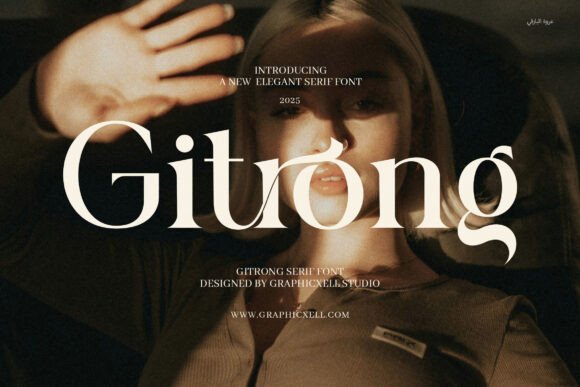
Gitrong is a modern serif typeface with refined proportions, gentle contrast between thick and thin strokes, and serifs that curve like calligrapher’s flourishes—never sharp, never fussy. Its letterforms feel intentional: the lowercase a and g have open counters for clarity at small sizes; the uppercase T and L hold strong vertical presence without stiffness; and the spacing between letters breathes naturally, even when tightly set on a 1.5-inch sticker or a candle jar label.
I use Gitrong most often where elegance needs to meet function: wedding welcome signs cut from birch plywood, boutique gift tags printed on kraft cardstock, seasonal greeting cards mailed across three states, and digital printables sold as Canva-editable planner pages. Because it’s a serif font built for real-world use—not just web headlines or magazine spreads—it holds up beautifully when scaled down to 8 pt on a tea towel tag or blown up to 24 inches for a farmhouse-style wall art SVG.
For product packaging, Gitrong adds perceived value instantly. Try it on a soy wax candle label beside minimalist botanical line art—it signals care and craftsmanship before the customer even smells the scent. On a hand-stamped leather luggage tag? It softens the ruggedness with warmth. On a holiday mug design? Paired with a subtle snowflake vector, it feels festive but never childish. The key is its balance: graceful enough for romance, grounded enough for rustic.
Readability matters—especially when your font goes through layers of production: designed in Illustrator → exported for Cricut Design Space → cut on vinyl → applied to glass or wood. Gitrong’s clean terminals and generous x-height mean it cuts cleanly on Silhouette Cameo and Cricut Maker machines, with minimal weeding needed on intricate serifs. No dropped stems. No fragile joins. I’ve used it successfully at 6 mm height for tiny enamel pin text and at 360 pt for large-scale event signage—and both versions felt legible, intentional, and commercially viable.
It shines brightest in display roles: titles, names, short phrases, and decorative accents. Think “Est. 2021” on a shop banner, “Hand-Poured” on a soap label, or “Mr. & Mrs.” on a foil-pressed invitation suite. While Gitrong isn’t intended for long paragraphs (it’s a display serif font, not a body text workhorse), its rhythm makes even two-word phrases feel like a signature—like your brand’s quiet handshake with the customer.
Pairing Gitrong thoughtfully unlocks even more versatility. I often combine it with a relaxed handwritten font for names or quotes—say, Gitrong for “Maple & Honey Co.” and a friendly script for “Small Batch • Locally Made.” For cleaner contrast, I’ll layer it with a warm sans serif like Montserrat or Poppins in a lighter weight for supporting text on product tags or social media graphics. And if you’re building a full brand identity, Gitrong works seamlessly alongside a bold geometric sans for logos and a neutral monospace for ingredient lists or care instructions.
The file package includes OTF and TTF formats—so it installs smoothly on Mac and Windows, loads reliably in Canva, Adobe Creative Cloud, Silhouette Studio, and Cricut Design Space. There are no hidden surprises: standard OpenType features like ligatures and stylistic alternates are included, giving you subtle polish without needing advanced typography knowledge. Multilingual support covers Western European languages, which means “Bakery,” “Café,” and “Éclat” all render cleanly—important if your stickers or printables serve bilingual markets or travel-friendly shops.
One thing I always double-check—and recommend you do—is the commercial license. Gitrong is cleared for physical product use: printing on stationery, cutting for vinyl decals, embedding in editable Canva templates, bundling into SVG bundles for Etsy, and even screen-printing on tote bags or apparel. You can sell items made with Gitrong without needing an extended license—no extra fees, no attribution required. That peace of mind matters when you’re batching 50 wedding favor tags at midnight.
Real examples from my own shop? Gitrong was the hero font on last season’s lavender honey jar labels—paired with a muted sage background and linen texture, it made a $12 product feel like a curated apothecary find. It anchored my spring printable bundle: “Grow With Me” garden planner pages, where its gentle curves echoed hand-drawn plant illustrations. And yes—it’s on the chalkboard-style welcome board I rented out for a local bridal shower. Guests snapped photos not just of the flowers, but of the typography.
If you’re choosing fonts for tangible things—things people hold, hang, wear, or give—you need more than aesthetics. You need reliability, licensing clarity, production readiness, and emotional resonance. Gitrong delivers all four. It doesn’t shout. It doesn’t distract. It simply makes your handmade work look like what it is: considered, capable, and quietly confident.
Whether you're designing for Etsy, local farmers’ markets, craft fairs, or wholesale boutiques, this serif font earns its place in your core design assets—not as decoration, but as infrastructure. A well-chosen typeface like Gitrong doesn’t just say what you make. It says who you are.