Yuzarsif Serif Font for Handmade Labels & Invitations
If you’ve ever spent hours searching for a font that feels both timeless and distinctive—something that elevates your handmade candle labels, wedding stationery, or boutique product tags without looking overly ornate—you’ll understand why Yuzarsif has become my go-to serif font this season. It’s not just another elegant typeface. Yuzarsif is a modern serif font with quiet confidence: clean enough for crisp Cricut cuts, expressive enough to carry emotional weight on a wedding welcome board, and culturally nuanced in a way that adds subtle depth to artisan packaging.
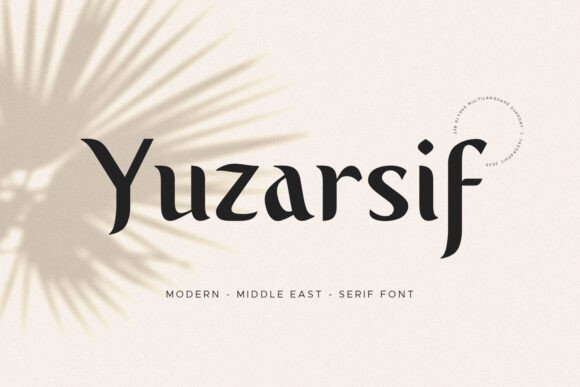
Visually, Yuzarsif balances structure and softness. Its letterforms have refined serifs and gentle contrast—thick strokes taper thoughtfully into thin ones—but it’s the subtle Middle Eastern influence that sets it apart. You’ll notice it in the graceful curve of the lowercase g, the balanced rhythm of the uppercase A and M, and the way characters sit comfortably side by side, even at small sizes. It doesn’t shout. It invites attention—and holds it.
For physical product makers, readability and cut accuracy are non-negotiable. I’ve tested Yuzarsif across multiple use cases: 8-point candle jar labels (cut flawlessly on my Silhouette Cameo), 12-point gift tags (crisp and legible after printing), and 36-point farmhouse-style wall art (where its warmth shines without overwhelming). Because it’s a well-kerned, professionally spaced serif font, it performs reliably at sizes as small as 6 pt for fine-print ingredient lists—and scales beautifully up to 120 pt for large-format signage or digital printable posters.
Here’s where Yuzarsif truly earns its place in my design toolkit:
- Wedding & event stationery: Use it for names on invitations, “Mr. & Mrs.” on ceremony programs, or “Welcome” on acrylic welcome boards—it reads as intentional, personal, and polished.
- Product labeling: My lavender honey jars now feature Yuzarsif for the flavor name (“Wildflower,” “Citrus Mint”) beneath a clean sans serif brand name—creating hierarchy without clutter.
- Digital printables: Planner covers, quote cards, and seasonal SVG bundles gain instant sophistication when Yuzarsif anchors the headline or focal phrase.
- Merchandise & home goods: It works on mugs, tote bags, and tea towels because its letterforms retain character even when simplified for screen printing or heat transfer.
- Seasonal crafts: For Eid, Nowruz, or holiday markets, Yuzarsif adds respectful cultural resonance without leaning into cliché—especially when paired with minimalist layout and warm-toned paper stock.
One thing I appreciate: Yuzarsif isn’t built for long paragraphs. It’s a display serif font—meant for titles, names, short phrases, and branding elements. That’s actually ideal for crafters. We rarely need full-body text in our physical products. What we do need is clarity, memorability, and a tone that aligns with our shop’s voice—whether that’s serene apothecary, joyful celebration, or grounded artisan.
Font pairing is where Yuzarsif really shines. Try it with a relaxed handwritten font for “Hand-Poured” or “Est. 2022” under your logo—then balance both with a neutral sans serif (like Montserrat or Inter) for ingredients, care instructions, or pricing. This trio gives you visual rhythm, personality, and practicality in one system. For digital templates sold on Etsy, I often set Yuzarsif as the editable headline layer, pre-paired with a compatible secondary font—so buyers get professional results without needing design experience.
Before purchasing, always check what’s included. Yuzarsif comes with OpenType features like standard ligatures and stylistic alternates—useful if you want to swap in a more decorative f-l or t-h combo for wedding monograms or boutique tags. It supports Latin-based languages and includes both .OTF and .TTF files, so it loads smoothly in Canva, Adobe Illustrator, Cricut Design Space, and Silhouette Studio. No missing glyphs mid-project.
A word on licensing: Yuzarsif is a commercial font, meaning you’re fully covered to use it in physical products you sell (like printed invitations or embroidered tea towels), digital downloads (printable planners, SVG cut files), and client work (custom wedding suites, shop branding). Just be sure your license permits resale—most premium serif fonts do, but always verify before listing a template or launching a merch line.
In practice, Yuzarsif helps me communicate quality before a customer even touches my product. A candle labeled in Yuzarsif reads differently than one in a generic Google Font—it signals care, intention, and attention to detail. That perception translates directly to perceived value, repeat purchases, and word-of-mouth referrals. It’s also helped unify my brand across formats: same font on my Instagram story banners, printable thank-you cards, and the foil-stamped tag tied to every order.
If you're building a cohesive, market-ready collection—whether it’s a set of Ramadan greeting cards, a line of ceramic studio labels, or a bundle of editable Canva wedding templates—Yuzarsif brings consistency without rigidity. It’s versatile enough to adapt to your aesthetic, yet distinct enough to become part of your signature style. And because it’s rooted in tradition but designed for today’s tools, it bridges the handmade and the digital seamlessly.
For crafters who treat typography as part of their material palette—alongside kraft paper, linen tape, and matte finish—it’s rare to find a serif font that feels this intuitive to use and this rewarding to present. Yuzarsif doesn’t ask you to compromise between beauty and function. It delivers both, quietly and consistently—every time you type a name, stamp a label, or export a printable.